.webp)
Maywood
Welcome to Home Point Appraisal, Your Trusted
Maywood
Real Estate
Appraiser
Maywood Appraisals Demand Attention to Small-Lot Density
Maywood is one of the most densely populated cities per square mile in California. At roughly 1.18 square miles with approximately 27,000 residents, the city packs more housing into less land than almost any other municipality in Los Angeles County. That density fundamentally changes how Maywood appraisals need to work.
In most LA neighborhoods, lot size is a relatively minor adjustment between comparable properties. In Maywood, lot size variations of 500 or 1,000 square feet between otherwise similar homes can represent meaningful percentage differences and drive significant value differentials. Original lots that have been combined, subdivided, or built on aggressively with ADUs and garage conversions trade on different fundamentals than untouched original lots.
I’ve appraised Maywood properties for over 25 years. The methodology requires recognizing how small-lot density affects comp selection and adjustment.
About Maywood
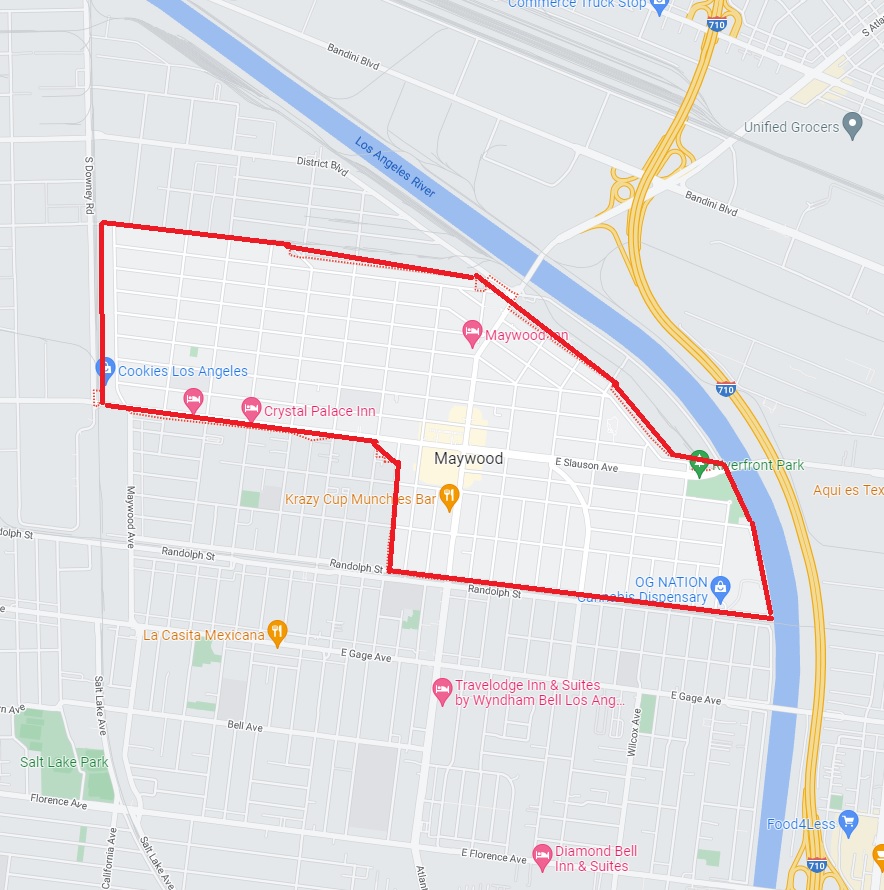
Maywood is a small incorporated city in southeast Los Angeles County, bordered by Bell to the south, Cudahy to the east, Vernon and the City of Los Angeles to the north, and Huntington Park to the west. The city sits on the eastern bank of the Los Angeles River and originated as an industrial-residential community in the early 20th century.
The dominant housing stock is small single-family homes built primarily between the 1920s and 1950s. Typical Maywood homes are 800 to 1,400 square feet on lots of 3,500 to 5,500 square feet, significantly smaller than the standard 6,000 to 7,500-square-foot lots common elsewhere in Los Angeles County. The grid street pattern, originally laid out for high-density residential development, packs more homes per acre than most surrounding cities.
The neighborhood is heavily owner-occupied with a significant multi-generational household presence. Many homes have been modified over the years with rear ADUs, garage conversions, and additions that take advantage of every available square foot of the small lots.
Why Small-Lot Density Affects Maywood Comp Selection
The Maywood market has several methodology requirements that don’t apply in larger-lot neighborhoods:
- Tighter lot-size adjustments. When standard lots are 4,500 square feet instead of 7,000, a 500-square-foot lot difference represents 11 percent of the total parcel, not 7 percent. The adjustment per square foot of lot has to be calibrated to this reality.
- ADU and garage-conversion impact. Many Maywood homes have converted detached structures or rear ADUs that add livable square footage but at lower per-square-foot value than the primary structure. Comps need to be analyzed for whether the listed square footage includes converted or accessory units, and whether those structures were permitted.
- Permit status of additions. Maywood’s density has led to widespread unpermitted additions, garage conversions, and second-unit construction. Permitted versus unpermitted square footage trades at different rates and affects financing. A defensible Maywood appraisal verifies what’s permitted before assuming it counts toward value.
- Block-by-block variation. In a city as small as Maywood, block-level variations matter more than they would in a sprawling neighborhood. Proximity to commercial corridors, schools, parks, and industrial buffers all show up at the block level.
Maywood Sub-Areas
Maywood is small enough that traditional sub-area distinctions are less defined than in larger neighborhoods, but a few orientations still matter:
- North Maywood. Closer to the Vernon industrial border. Some properties have exposure to industrial activity that affects value.
- Central Maywood. Around the central residential blocks. Most stable comp pool for typical residential appraisals.
- South Maywood. Closer to Bell. Some south Maywood blocks blend gradually with adjacent Bell values.
Common Maywood Appraisal Scenarios
The work I do in Maywood typically falls into a few categories.
- Probate and Date-of-Death Valuations. Many Maywood homes have been owned by the same family for two or three generations. The date-of-death appraisal establishes the IRS step-up basis, which is often the single most valuable financial document the heirs receive.
- Estate Planning and Trust Valuations. Long-term Maywood owners often hold homes in trust. Trust appraisals support gift tax planning and stepped-up basis purposes.
- Divorce Valuations. Maywood homes are typically the largest asset in a divorce. Documentation has to hold up in family court, and the permit-status questions described above often become contested points.
- Pre-Listing Valuations. Sellers preparing to list benefit from an independent valuation that correctly handles the lot-size and permit considerations that automated valuation models routinely miss.
- After Repair Value (ARV) for Investor Work. Maywood has an active small-scale investor market. ARV appraisals analyze what planned renovations will produce in market value once completed.
Why Choose Home Point Appraisal for Maywood
Maywood appraisals require an appraiser who understands small-lot density and who can credibly verify the permit status of additions, ADUs, and garage conversions that affect square footage and value.
When you hire Home Point Appraisal for a Maywood property, you’re getting:
- USPAP-compliant reports built for court, IRS, and lender scrutiny.
- Direct access to me. No outsourced inspections, no junior appraisers.
- Comp analysis calibrated to small-lot density and permit-aware adjustments.
- 3 to 4 business day standard turnaround on most reports.
Maywood Landmarks That Affect Property Value
- The Los Angeles River. Forms Maywood’s western boundary. Properties along the river have proximity effects that vary by block.
- Vernon industrial corridor. Directly north. Properties closer to the Vernon border have industrial-adjacency considerations affecting both value and livability.
- Atlantic Boulevard. Eastern commercial corridor. Properties within walking distance benefit from commercial access.
- Slauson Avenue. Northern commercial corridor. Significant traffic and commercial activity affect adjacent residential blocks.
- Adjacent cities (Bell, Cudahy, Huntington Park). Maywood’s value gravity is heavily influenced by these neighboring small cities, all of which trade on similar small-lot residential fundamentals.
Get Your Maywood Appraisal Started
Call 213-739-9267 or click the red button below for an instant quote. Most Maywood appraisals can be scheduled within 48 hours, with the completed report delivered 3 to 4 business days after inspection.
Save $50 with code 50WEB25 at checkout.
Why Choose Home Point Appraisal?
With over 25+ years of experience in the SoCal real estate industry, we have expertise and knowledge of your local market. Call us for fast response or click the button below to get an instant quote.
GET INSTANT PRICING NOW

.webp)